Choose at least three examples of artists/companies from a list and research their work in relation to florals, find out why their motifs are important.
William Morris
I love William Morris. I mostly know of him from Kelmscott Press, his wallpaper designs, and his love of romantic fiction. I did not know that he was mostly known as a writer and activist in his time.
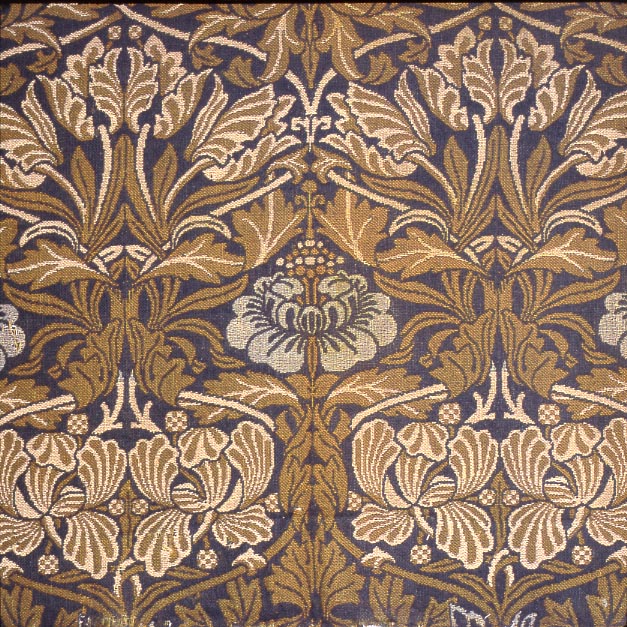
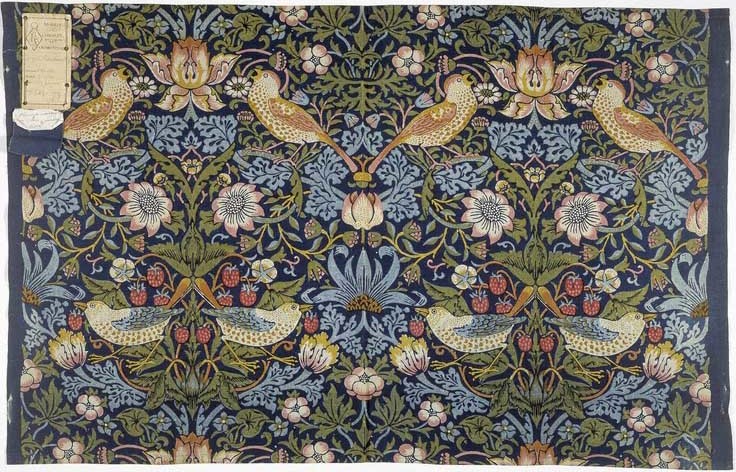
As an artist and designer Morris believed a design should not be separate from the production/creation of the object. Something should be designed and created by the same pair of hands. Living during the Industrial Revolution he rebelled against mass production and insisted on good quality raw materials, natural dyes, and hand crafting. This period also saw an awareness of the environment, concerns about pollution and workers.
Morris grew up in the countryside, surrounded by nature. His family home was full of historical books – romances, and illuminated manuscripts and tapestries. He did almost exclusively use nature in his designs. Repeating patterns, using natural colours, understanding but never copying plants, thinking it was impossible to imitate nature. According to Morris patterns should have “beauty, imagination, and order.”
Nature is the dominant theme with his designs. Morris wanted to bring nature into peoples homes at a time when industry seemed to be severing our connection to to it. He wanted to keep that connection to nature that he felt was important to a person’s well being. His wallpaper designs were a way to do that. Bringing the outside in. Hoping that people would spend more on a well crafted, beautiful design, that would last longer than mass produced decor.
Morris always used native plants and flowers. Victorians had become interested in new, exotic and vividly coloured plants and flowers from abroad. Greenhouses and hothouses were on trend for them and this was something that didn’t seem to interest Morris. It seems to me that Morris was quite the rebel. Rebelling against the Industrial Revolution, technology, mass production, garish plants and fashions, and the severing of our connection to nature.
Sources
https://www.bbc.com/culture/article/20190909-the-first-eco-warrior-of-design
https://williammorristile.com/articles/morris_arts_and_crafts.html
Takashi Murakami
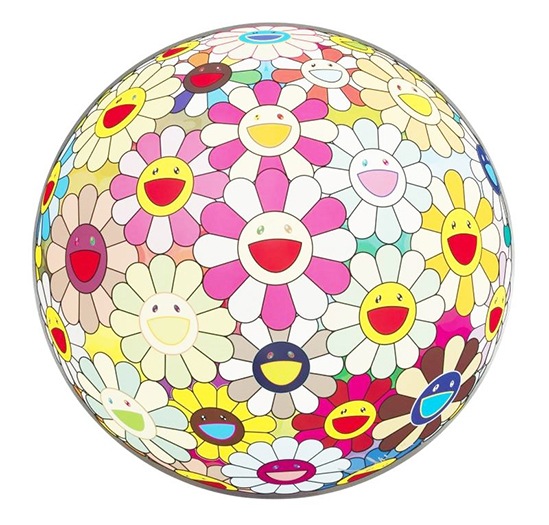
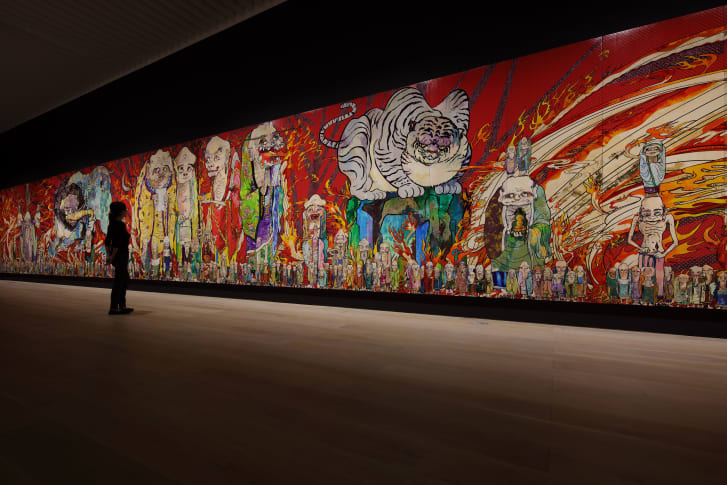
I picked Takashi Murakami because I didn’t really like the first pictures I saw of his art. I thought it would be interesting to see if learning about him changed my mind (spoiler alert – it did). Murakami is often referred to as the “Warhol of Japan”, he is mostly known for pop style artworks of brightly coloured smiling flowers, mushrooms, skulls, and Buddhist iconology. I had thought of him as a designer of merchandise really. His art is very colourful and a bit “trippy”.
Murakami coined the term “superflat” which he says is an aesthetic that combines traditional Japanese art with more contemporary Japanese pop culture.
The smiling flowers are what he is most known for even though he has painted a variety of subjects. A lot of his work has a root in catastrophe and New York Times ran an article in which he says that the smiling flowers evoked contradictory emotions and the collective trauma of the Japanese people triggered by the Hiroshima and Nagasaki bombs. He has also painted in reaction to the 2011 tsunami, which led him to add a spiritual element to his work through studying Buddhism and trying to understand why the Japanese people believe in many gods.
On one of his Instagram he mentions to “always be smiling” I don’t think this is to mask/ignore pain but as a way to heal. The bright colourful, seemingly frivolous designs and artwork have so much depth spiritually, emotionally, and historically. It has even led to him creating an installation at Washington DC’s Children’s National Hospital. He took over the scan suite and covered it with his smiling flowers in an effort to help children be less frightened of their procedure.

Sources
https://www.myartbroker.com/artist/takashi-murakami/a-buyers-guide-to-takashi-murakami-prints/
https://www.architecturaldigest.com/story/takashi-murakami-rxart-childrens-national-hospital
https://edition.cnn.com/style/article/takashi-murakami-identity/index.html
Tord Boontje
I am a bit embarrassed to say that I had not heard of Tord Boontje before, although some designs looked familiar as I looked into him. he is a Dutch designer who has worked for Alexander McQueen, Habitat, Swarovski, and Tate Modern.
He describes his process as “spontaneous, not organised, and symmetrical”
His upbringing led to him starting out with modern, utilitarian styles of design but after the birth of his daughter he took a softer approach. Feeling the need to “nest” his designs took a more fantastical and delicate turn. Like William Morris he wanted to bring a reconnection to nature into peoples homes. This was also a very deliberate challenge to minimalism which was the trend at the time – the early 2000’s.
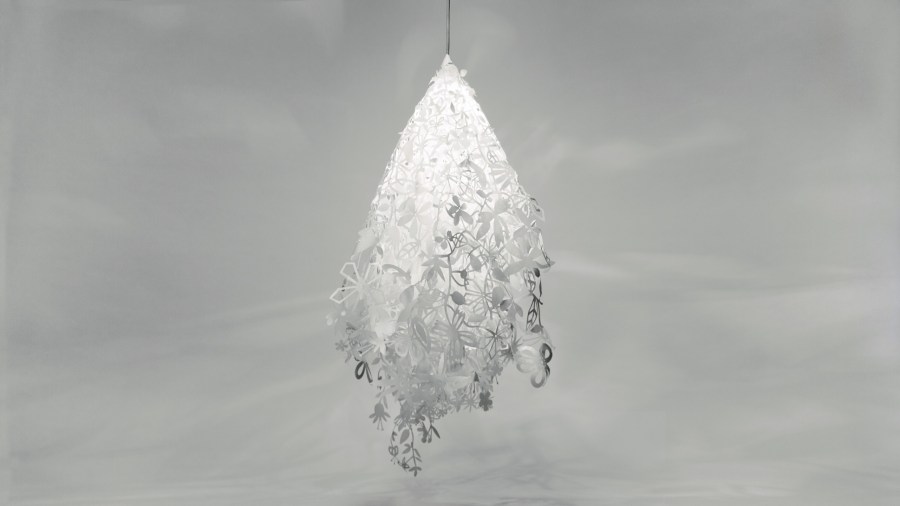
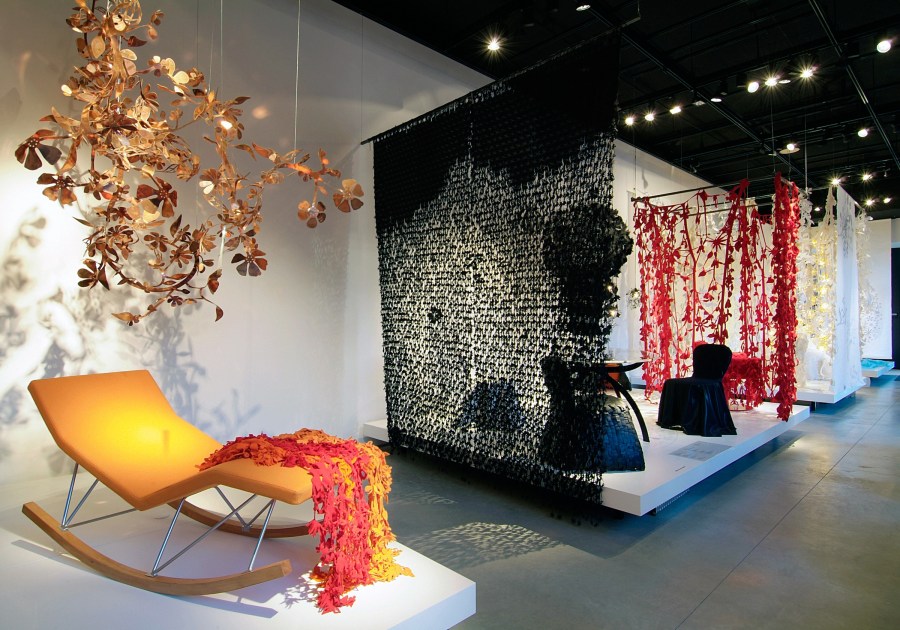
Nature and light are recurrent and important themes in Boontje’s work. He also like to contrast hard and soft ideas in one piece. He will use hard materials to create fragile dreamy designs. His design Midsummer Light encapsulates all is themes in one piece. Hard materials made into a highly detailed, fragile looking floral drop lampshade, which casts gorgeous shadows around the room.
Boontje says this design was inspired by lying under a tree and seeing the sunlight through the leaves. His vision is for people to be more aware of nature and it’s fragility. Personally it feels like he’s updated William Morris’s ideals of the reconnection to and protection of nature.

Sources
https://www.theguardian.com/lifeandstyle/2003/mar/08/shopping.homes
I think all the artists I chose to research show how art helps us make sense of the world, our corner of it, and our place in it. Nothing is designed by accident or casually. Everything has come from a definite ideology or need for understanding. Nature is not only a pattern sourcebook but the driving force of why we make art/design.
 laineyrainjournals.com